The Integrity Web
Explained by the
Co-Inventor of STARKs
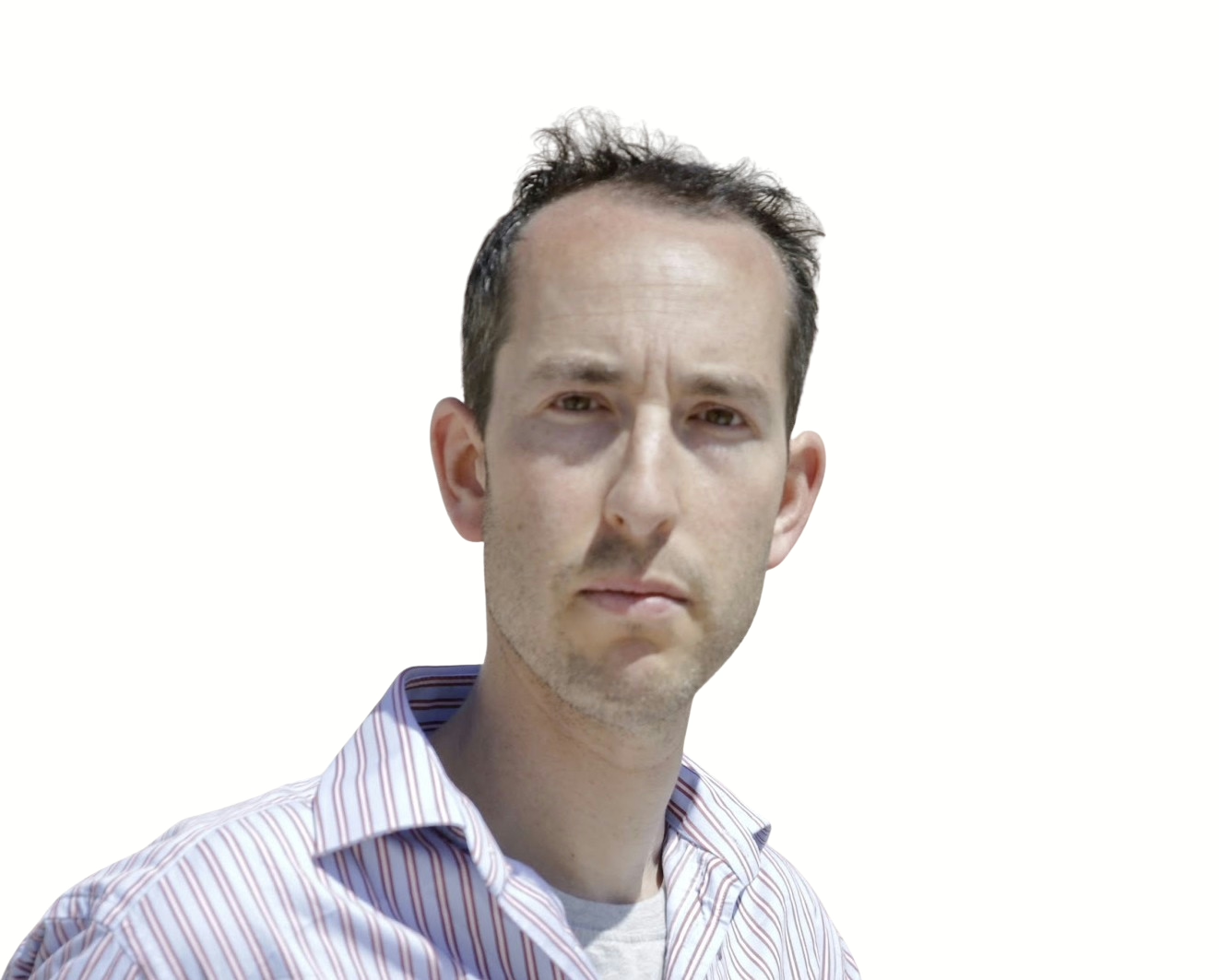
A future internet where trust comes from mathematical proof, not institutions. An essay by Eli Ben-Sasson, adapted from Zero Knowledge, Infinite Trust.
The internet of the future
The Integrity Web is the way the internet of the future will be built. It will no longer rely on big tech to write the rules. The people who use the internet will become the people who control it.
Today we put our trust, our data and our money into the hands of vast corporations and financial institutions. They take care of our bank accounts, our messages, our photos, our personal search histories and our digital identities. But tomorrow’s internet will, I believe, be built on a different foundation. Our interactions will be verified not by today’s faceless intermediaries, but by a technology that creates trust through mathematical certainty.
“What happens on the Integrity Web stays with you. It follows you, sticks to you like glue, everywhere and forever, in a good way.”
“What happens in Vegas stays in Vegas,” or so the saying goes. I see the Integrity Web as a polar opposite of Sin City. The Integrity Web will transform our online world. The blind faith we currently put into institutions will give way to full transparency. Our data and our money will be back in our own hands.
Today we are connected in ways our parents and grandparents could never have imagined, but we’re paying a heavy price. Our private lives have become commodities, our personal details are bought and sold.
But let’s not forget that the internet is still in its infancy. There was no public grid when the electric light bulb first replaced candles in the 1880s. Power was generated locally because it could only be transmitted half a mile. In the same way, the worldwide web we see today is just the first draft, an early incarnation that can evolve into something radically different.
Re-inventing the clay tablet
Thousands of years ago, early man found ways to record transactions, long before he could read or write, long before he had money in his pocket. He’d press symbols into clay tablets, documenting the fact he’d traded one of his sheep for his neighbor’s wheat. Once that tablet was fired, it could no longer be altered. It was an ancient precursor of the “immutable ledger” that we know today as blockchain.
The clay tablet served its purpose, but the very thing that gave it strength - its uniqueness - was, at the same time, its greatest weakness. It couldn’t be replicated. Then Gutenberg came along with his printing press in the 15th century and knowledge could be shared as never before. My contracts, my promissory notes, my shipping manifests, my everything, could suddenly be distributed far and wide. The clay tablet represented a single version of knowledge. The printing press produced countless identical copies of that knowledge. Unfortunately every leap in record-keeping from clay to ink and beyond has provided bad actors with a new set of tools.
Fast forward five centuries and the internet is now sharing knowledge more widely and more quickly, to the screens on our desks and in our pockets. But it is a double-edged sword that has opened up endless opportunities for forgeries, fraud, and corruption.
The next step on this journey is blockchain, which uses cryptography - a complex set of mathematical rules - to fix the internet’s trust issue. Like the clay ledger we mentioned earlier, it creates a single, incorruptible record of truth. But in a way that can be shared and checked by anyone. So you might think ledger plus internet equals the best of worlds? Well, not quite.
Blockchain’s two big hurdles
Blockchain does offer a highly effective solution to the internet’s trust issue. It links every block of data to every other block of data with a cryptographic “fingerprint”. That makes it virtually impossible for anyone to tamper with the data in every block to corrupt the record. So far, so good, but blockchain still has two major hurdles to overcome.
The first is the way it operates, with huge networks of high-powered computers racking up crazy electricity bills. That makes it impossible to scale up. There’s no way, in its current form, it could handle even a fraction of the world’s transactions. And the second is the fact that it’s a public ledger, which means it reveals far more than users would like about their private business.
As an academic, busy researching an obscure area of math called zero-knowledge proofs (ZKPs), I was blissfully unaware of all this. Until that eureka moment, when I suddenly realized that what I had was the very thing that blockchain needed. Zero-knowledge proofs address both the privacy issue and the scaling issue that were holding back the nascent blockchain.
This is what ZKPs say: “I can now prove something is true beyond question, without revealing too much detail.” I have the funds to buy this car, for example, but I’m not showing you my bank balance. I’m over 18 but I’m not telling you my date of birth. ZKPs also do something vital that addresses the issue of scale. They shrink down thousands of transactions into one tiny proof. Only the tiny proof needs to be published on the blockchain. Think of a QR code that encodes an entire warehouse full of goods.
Beyond blind trust
This tiny proof offers us a glimpse into a whole new layer of the internet, one that is built on verified truth rather than blind trust. It’s what I call the Integrity Web. It uses cryptography to guarantee honest behavior, to make sure our data and our money cannot be stolen or manipulated.
Such fears are perfectly justified. Millions of people in Argentina had their bank accounts frozen during the financial crisis of 2001. Those holding US dollars lost more than half their savings when they were forced to exchange them for pesos. We believe our money’s safe in the bank, until it isn’t.
Likewise, we put our trust in fragile pieces of paper to prove we own a property, that we are married, or that we graduated from university. We write wills, we sign contracts, we carry printed passports, but we need better ways to protect our money and our documents.
In Honduras farmers face a constant struggle to prove they own the land they farm. They rely, at best, on a tattered document that can be lost, faked or forged, and at worst on a verbal agreement made by their great-grandfather. Digitizing those records and publishing them to a blockchain would banish doubt and prevent a bad actor from trying to rewrite history.
Trust also goes beyond what we own, it extends to the “society pillar” - who we are and who we know. Consider your entire social media history - every post, every picture, every like. You don’t own it, and if the platform closes, it’s gone forever. The Integrity Web would make it portable and give you ownership.
“The Integrity Web lets us prove the money is ours, rather than entrusting it to a bank that can freeze or confiscate it at will.”
It means documents that could otherwise be lost, stolen or tampered with now live on forever. It’s all about owning your life.
Meeting real-world needs
I don’t honestly know whether my own title for the internet of the future - Integrity Web - will catch on. I suspect somebody will coin a catchier name. But I do know that it will emerge organically to meet real-world needs and I’m proud that my obscure math will have played a role in its development.
My specialty as a university professor was the zero-knowledge proofs I mentioned earlier. This is how they work. Imagine a whole day’s worth of payments made to a large company, or thousands of welfare checks issued across an entire city. I want to publish that activity to a blockchain, so that anyone who needs to check it can do so. The problem is that there are gigabytes of raw data, which would make it unmanageable and impossibly expensive.
That’s where a validity proof comes in. It asserts that everything is correct, then shrinks all that data down to a string of characters that could be printed on less than an A4 sheet of paper. Only that string of characters needs to be published. Once you have a collection of validity proofs, you can then use a recursive proof, which verifies them all and says: “These are all good.”
STARKs are the cryptographic engine that does the heavy lifting behind all of this. They’re a particular type of zero-knowledge proof system, from which the StarkWare company takes its name.
The beauty of math
I happen to love the math behind STARKs and the Integrity Web. It’s my world, but it doesn’t need to be yours. What matters is that math is absolute - two plus two will never equal five - and it’s math that underpins the Integrity Web.
I confidently expect the Integrity Web to come of age over the next five years and to start becoming a part of everyday life, even if it’s invisible to all but those with a passion for obscure math.
The goal is not for people to understand validity proofs or STARKs, simply for them to enjoy the benefits. The math that makes them work will happen seamlessly in the background. That’s actually the easy bit. The real challenge is actually making it happen, actually weaving the Integrity Web into the fabric of ordinary life in a way that is honest, inclusive, and genuinely useful.
I’m not interested in the Integrity Web as some niche experiment that’s remembered only as a footnote. I see it as the future default, a system that quietly secures our money, documents, and digital identities, and lets us prove they are ours - not because a bank or a server says so, but because rock-solid math guarantees it.
The full argument,
in 320 pages.
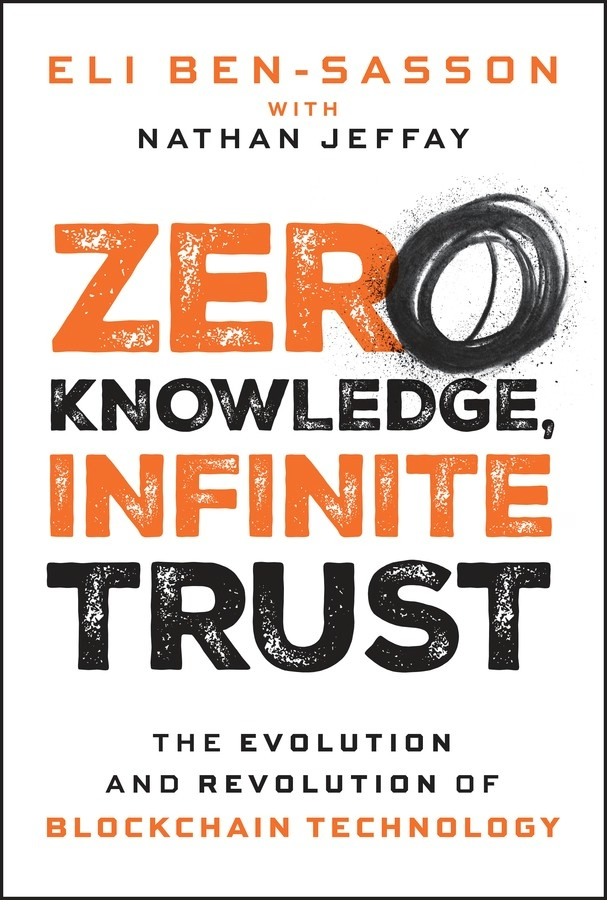
The essay you just read is one strand of a much larger story. Zero Knowledge, Infinite Trust traces how zero-knowledge proofs work, why they matter, and the case for an internet built on mathematical certainty rather than blind trust.
By Eli Ben-Sasson & Nathan Jeffay · John Wiley & Sons · ISBN 978-1-394-37382-6