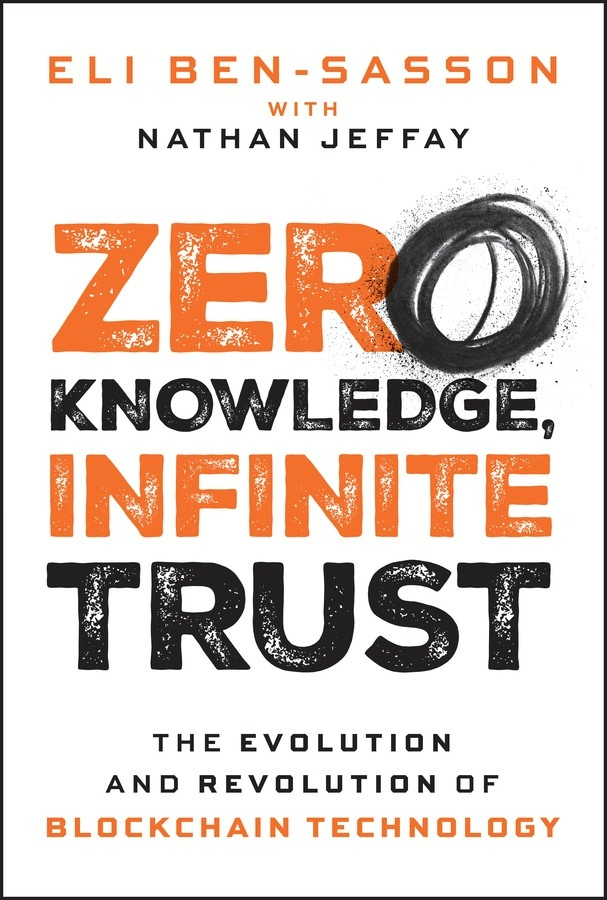
4-Minute Guide to
Zero Knowledge,
Infinite Trust
The book in sixteen quotes. The best bits, lifted straight from the page - on privacy, blockchain, AI accountability, and the Integrity Web.
Handing Over Control to Black-Box Systems
“Do we want to hand over so much control to others, slipping it into [big tech’s] black-box systems with no guaranteed way to see exactly what’s happening to it? If there is another way that is just as convenient, we believe almost every human alive would opt to use it.”
“We live inside information systems that are extraordinarily powerful—but almost entirely unaccountable. These systems neither love us (though they are programmed to make us feel like they do) nor hate us. In reality, they just care about what can be measured, because that’s what generates money for them.”
On Privacy
“In a free society, privacy doesn’t need a justification. Intrusion does. Paying in cash doesn’t make you a money launderer. Closing a door to make a phone call doesn’t mean you’re plotting a crime. Privacy is about preserving agency, not concealing guilt. And financial privacy is no exception.”
The Crisis of Trust Online
“Just like the first four decades of electricity seem somewhat quaint looking back today, the first four decades or so of our online existence will soon feel equally primitive. Why? Because today we run our lives via the internet, but pay our way online with money that really isn’t internet-appropriate.”
“The question we should all be asking is: How do we know we can trust what they’re doing? That’s exactly where mathematical proofs come in.”
Engineering Trust Instead of Asking for It
“At its core, blockchain is a system that will redefine how we carry out some of our most important interactions with other humans—moving value (money), determining what records are accurate (documents and data), and coordinating at scale (human beings and human society).”
“In short, a public blockchain is a shared ledger of truth. It doesn’t require trust in a central figure. Instead, it relies on structure math, cryptography, and a network of computers—not on trust in people, companies, or governments.”
Trust Without Surveillance
“With blockchain, the system stays honest. The individual stays private. This isn’t a hope—it’s already happening.”
“What should worry us is the growing normalcy of a world where every payment is tracked, stored, and scrutinized by default.”
The Unique Way Blockchain Creates Trust
“Picture driving a car with a steel spike mounted in the center of the steering wheel, aimed straight at your chest. You wouldn’t take reckless chances, not because you’re virtuous, but because the cost of a mistake would fall on you first.”
“So the lesson is simple: in Bitcoin, honesty isn’t about virtue. It’s about self-interest. The spike is always on the wheel. You can grab it if you want—but you’ll be the one who bleeds.”
Why AI Must Become Checkable
“AI systems and algorithms determine how we understand the world around us. And it doesn’t stop there. Credit-checking agencies act as judge and jury over whether you can sign up for this or that service, based on their collection and interpretation of your records.”
“In fact, the more technologically advanced we become, the greater the need for consensus—as anyone can produce in minutes using AI what look like official documents. What we need is ways to prove beyond doubt which documents are legitimate, authoritative copies.”
“The goal isn’t perfect AI. The aim is visible failures and answerable power. And in a world where more and more decisions are being made by code—determined automatically by computer programs, algorithms, or AI rather than humans—that visibility may be the difference between being governed by machines and coexisting with them under shared norms.”
How Zero-Knowledge Will Verify AI
“On something this important, there should be a compliance stamp—a mark showing that the code matches the stated principles, and that it hasn’t been quietly changed. This is precisely the type of accountability that zero-knowledge-enabled blockchains can deliver.”
“Instead of revealing every input, zero-knowledge blockchain systems produce a cryptographic proof that the rules were followed and that the outcome is correct. Often that outcome is a simple bottom line—who is recorded as owning which funds—but the idea extends far beyond money, and turns out to be a good fit for certain aspects of AI.”
Taking Power Back from Big Platforms
“Blockchain is about rebalancing that power and cutting out this huge web of middlemen that exert so much control.”
“For the first time, ownership can sit with the participant rather than the landlord. This is what I mean when I say: you own your life.”
The Internet Will Eventually Become Blockchain
“In the history books of the future, the rise of the internet won’t merit a chapter of its own. True, the world changed entirely when technology suddenly connected billions of people. But the story of the internet will be so intertwined with that of another innovation—blockchain—that they’ll be told together as one.”
“Generations to come will neither know nor care where one story ends and the other begins—so much so that the specific terms internet and blockchain will be virtually forgotten.”
“That’s why I refer to what I’m convinced will become our digital go-to infrastructure of the future as the integrity web.”
Blockchain Beyond Speculation
“Headlines fixate on price swings and regulatory squabbles. The deeper story—why these technologies matter—is too often lost.”
Changing Careers to Chase Trust
“I entered business to help address trust: not by changing the rules, but by scaling the systems. Armed with novel cryptography, we set out to help blockchains handle far more activity—without losing the decentralization and trust guarantees that made them worth caring about in the first place.”
Why Zero-Knowledge Proofs Matter
“ZK STARKs, which I co-invented, can do something remarkable: they allow you—or anyone on the planet—to verify the math behind an entire year of global financial activity, without redoing the math yourself.”
“Zero-knowledge proofs are what I call the ‘have-your-cake-and-eat-it-too’ cryptography. They let you prove a transaction followed the rules—without revealing the details of the transaction itself.”
Blockchain Meets Deep Needs of Humanity
“What blockchain offers is such a unique fit for the deep needs of humanity that its mass adoption is inevitable.”
“Blockchain can deliver a shared layer of integrity beneath all of this—a system where records live independently of any one institution.”
“At its core, blockchain is a powerful tool. Its value depends on who wields it and how they wield it. The question is not who owns it, but who builds with it, and what they build to benefit humanity. That question is no longer just about technology; it’s about the kind of world, digital and otherwise, that we choose to build. Nathan and I hope that you carry with you the vision of an Integrity Web—a new kind of internet where honesty is built in, where trust is no longer fragile, and where integrity is guaranteed by design.”
The Breakthrough Realization
“Realizing that ZK proofs solve both privacy and scalability was the eureka moment I had at that Bitcoin conference. The additional thrill? Realizing I might be the first person in the world to see this.”
The Ultimate Vitalik Origin Story
“Startups often start life with a seed round of funding, priced on spreadsheets in a boardroom (pricing means determining the valuation of an early-stage startup). This one was a bit different. It was priced almost without words, in a rather pungent fish market in Shenzhen.”
“The genius co-founder of Ethereum, Vitalik Buterin, was at an academic crypto conference in Shenzhen, in the Chinese province of Guangdong, and so was I. We took a stroll together in the neighborhood and ended up at the market as the fishermen were closing their stalls for the day. Vitalik spoke Mandarin with the locals (apparently, one of the many languages he speaks).”
“Then, at some point during our walk I asked: ‘Would you be willing to price our seed round?’ He said ‘Err, hmm.’ In Vitalikese, this means ‘Yes, sure!’ So I suggested a round of $6 million. Another ‘Err hmm,’ which meant ‘That’s about right.’ And thus, the seed round pricing was sealed, in a fish market in Shenzhen.”
Sixteen quotes,
three hundred pages.
Those quotes are the highlights. The argument that ties them together - how zero-knowledge proofs work, why they matter, and the case for an internet built on mathematical certainty - lives in the book.
By Eli Ben-Sasson & Nathan Jeffay · John Wiley & Sons · ISBN 978-1-394-37382-6